
16 Years of Chronic Hand Pain Resolved in 16 Weeks
Written by Dr. Matthew Hwu, PT, DPT, OCS, CSCS
Before
16 years and $15,000+ in failed treatments. Could not hold a mouse for 5 minutes. Bilateral pain across a dozen sites. Relied on dictation and a foot mouse.
After (16 Weeks)
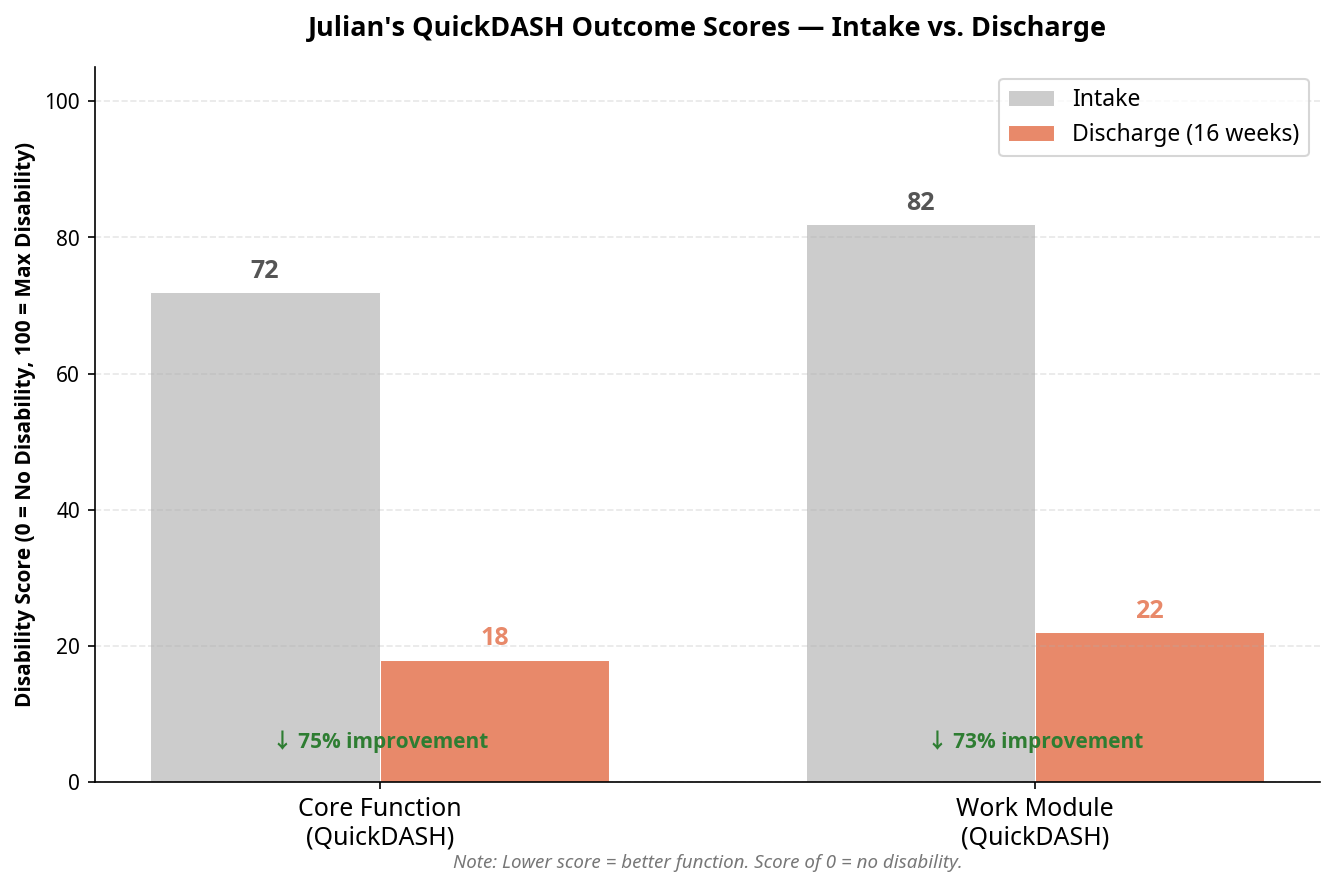
QuickDASH core score 72 → 18 (75% improvement). Full workdays trading with a mouse plus 4–6 hour gaming sessions with no fear.
Table of Contents
Julian's Story
Julian spent 16 years trying to fix his hands. He saw multiple doctors and specialists. Tried occupational & physical therapy. And through all of these he also tried every device he could find: a vertical mouse, a foot mouse, dictation software. He even tried using AI (ChatGPT) to get some guidance.
Every MRI came back normal. Every EMG came back normal. Every specialist told him some version of the same thing: “We don't know what's wrong,” and kept him in a loop of care that never yielded any results. At his worst, Julian could not hold a mouse for five minutes.
Julian is a trader and lifelong gamer, and over the years of dealing with his wrist pain he saw his ability to work and play games steadily disappear.
“I was pretty hopeless after so many years of dealing with this issue.”
This is when he started with 1HP. And in 16 weeks, Julian went from full dictation with no mouse use to a full day of work with the mouse and six-hour gaming sessions (same day). Here is exactly how we did it.
Clinical History & Relevant Information
Julian is a full-time crypto trader. His entire workday is spent at his PC for trading, researching and monitoring his positions. On top of that, he is an avid gamer who would spend several hours after work gaming. His daily schedule at intake looked like this: 8–10 hours of PC use split across trading and gaming, with walking as his only physical activity.
The pain started gradually and spread. By the time Julian found 1HP, he described it as pain “from my fingertips down to my forearm on both arms in a dozen different spots.” He could not point to a single trigger. This is important to point to as we get into the later sections around sensitization. The pain was moderate to severe every day, with limited moments of relief.
Over the 16 years that Julian had dealt with the pain he spent more than $15,000 going through the full gauntlet of traditional care. He saw a hand specialist who ordered X-rays and an EMG (which both came back negative). He had an MRI which was “normal,” and after all of these his specialist's only options were to try pain management and cortisone shots (he declined).
During this time he also attempted two courses of physical therapy which had caused him too much pain to stay consistent. He would perform them for a few days and felt an increase in symptoms. During these moments he was never educated on how to best respond to any increase in symptoms — how to determine what is actually irritating tissues versus what is actually considered strain. Because of this, every “flare up” would lead to resting for a week and repeating the cycle.
Ultimately after trying everything he became fearful of using his hands, adopted a lot of avoidance patterns and was not able to use his hands at all. This is when he found us on Reddit.
The Assessment: What Was Actually Going On
Here is what we found after our initial full clinical assessment to understand everything about his injury. We explored pain regions and behavior, complete medical history, his daily activity patterns, his ergonomics, understanding of pain and our standardized endurance test.
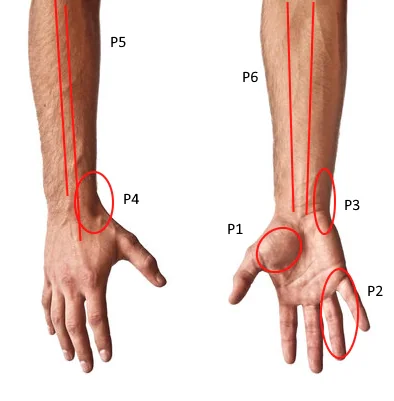
Pain Regions: Bilateral wrist and hand pain (right dominant), extending into both forearms. Thumb involvement bilaterally. Pain at a dozen different sites, with no clear single diagnosis from prior providers.
Baseline Endurance Test (Right Hand):
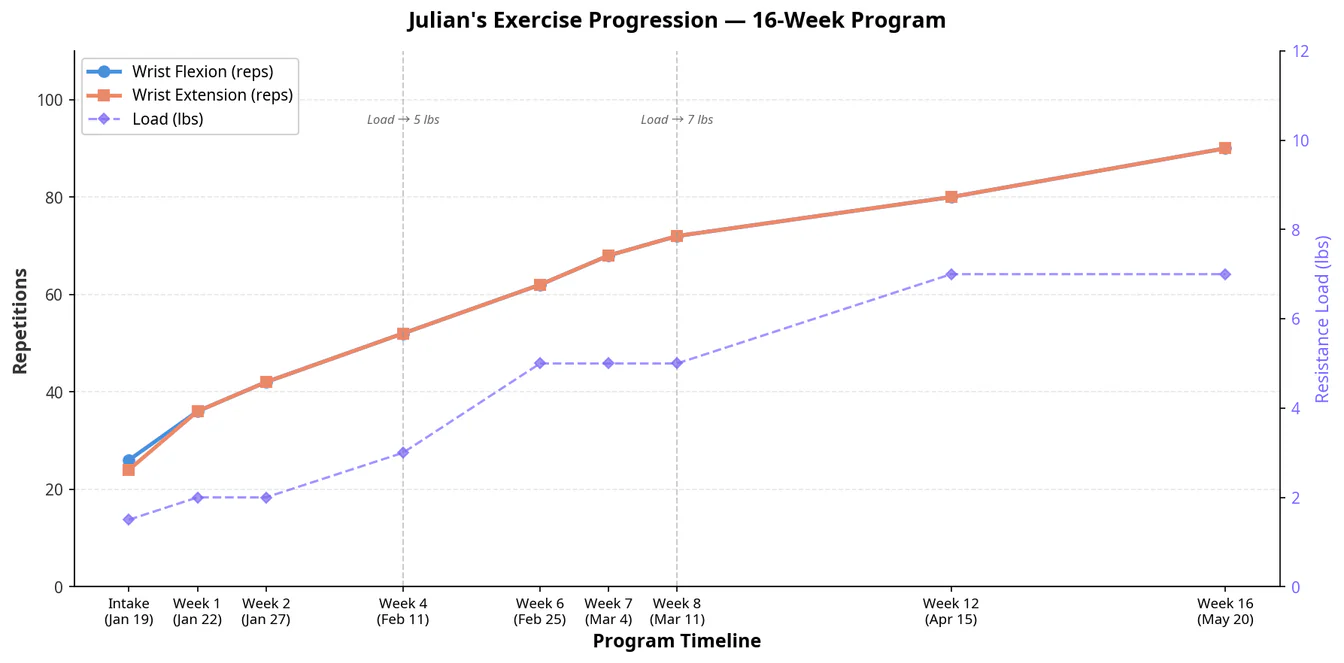
- Wrist Flexion: 26 reps at 1.5 lbs, 1.1% of his bodyweight before pain onset (FCU involvement)
- Wrist Extension: 24 reps at 1.5 lbs
- Thumb Flexion: 25 reps before pain
For someone spending 8–10 hours a day at a computer, this was a significant deficit. His muscles simply did not have the capacity to handle what he was asking of them.
| Wrist & Hand (Bilateral) | |
|---|---|
| What was happening? | P1: Thumb Flexor Tendinopathy; P2: FCU Mediated Cubital Tunnel Syndrome, FDS/FDP Tendinopathy (Digits 3/4); P3: Distal FCU Tendinopathy; P4: APL/EPB Tendinopathy; P5: Extensor Digitorum Muscle Strain & Tendinopathy; P6: FDS/FDP Muscle Strain & Tendinopathy |
| Pathomechanics | Demand exceeded capacity: pain with sustained typing, clicking, and gaming; sensitized tendons responding to normal loads as threatening. High-APM gaming and prolonged phone use; repeated micro-loading without recovery; sensitization amplifying pain signals |
| Baseline Endurance Test (3 Most Relevant) | Wrist Flexors: 26 reps at 1.5 lbs; Wrist Extensors: 24 reps at 1.5 lbs; Thumb Flexor Endurance: 25 reps each side before pain onset |
| Symptoms and Functional Deficits | Pain 3–6/10 at rest, spiking to 7–8/10 with use; unable to hold mouse for 5 minutes; used dictation and foot mouse as workarounds; pain with texting, controller use, and any fine motor task; intermittent numbness in left hand; 20 minutes of phone use would lead to 4–6/10 taking 1 hour to go down |
The Fear-Avoidance Component
Julian was stuck in a classic fear-avoidance loop that developed as a result of his experiences with healthcare and what he had been exposed to online for 16 years. Every time he tried to push through, the pain spiked. So he stopped. He rested. He avoided. His hands got weaker. The next time he tried, the pain came back faster. He rested again. And the cycle continued, year after year.
He had tried at-home exercises multiple times. But because he had no guidance on how to dose them, he would do too much, flare up badly, and stop for a week. The inconsistency meant he never built any real capacity.
“If I felt pain, I would stop. And then rest. And keep resting. And just repeat the cycle over and over.”
These repeated cycles were a result of 16 years without any clarity from any healthcare providers about:
- What is actually going on with his wrist & hand
- Why certain interventions will allow him to begin to use his hands more over time — not just reduce the pain
- How to understand what he is feeling in response to the exercise and load-based interventions at various stages
- Why it is normal for him to feel pain considering his poor endurance and overall lifestyle
- What it meant for his pain to spike in response to specific activities but also considering his entire clinical picture (conditioning, sensitivity, lifestyle)
This lack of clarity and understanding led to maladaptations in his nervous system. His brain had learned that hand use equals danger. And of course his directed experiences of rest and passive interventions would reinforce this. Every time he tried to use a mouse again he would feel pain that would last for hours to days. Even lower loads of wrist & hand activity were being interpreted as threatening. This is called central sensitization.
It is not “just in your head.” Real neurological changes occur when pain persists for this long without resolution.
His fear of re-injury was not irrational. It was a learned response to 16 years of failed treatments and no clear answers. But it was also the thing keeping him stuck. This was an essential cognitive pattern we had to address.
The Recovery Plan
Julian's program was focused on:
- Addressing his limited endurance (20–30% of what was considered normal for his bodyweight)
- Improving his understanding of pain to better reprocess his pain experiences
Phase 1: Building the Foundation (Weeks 1–4)
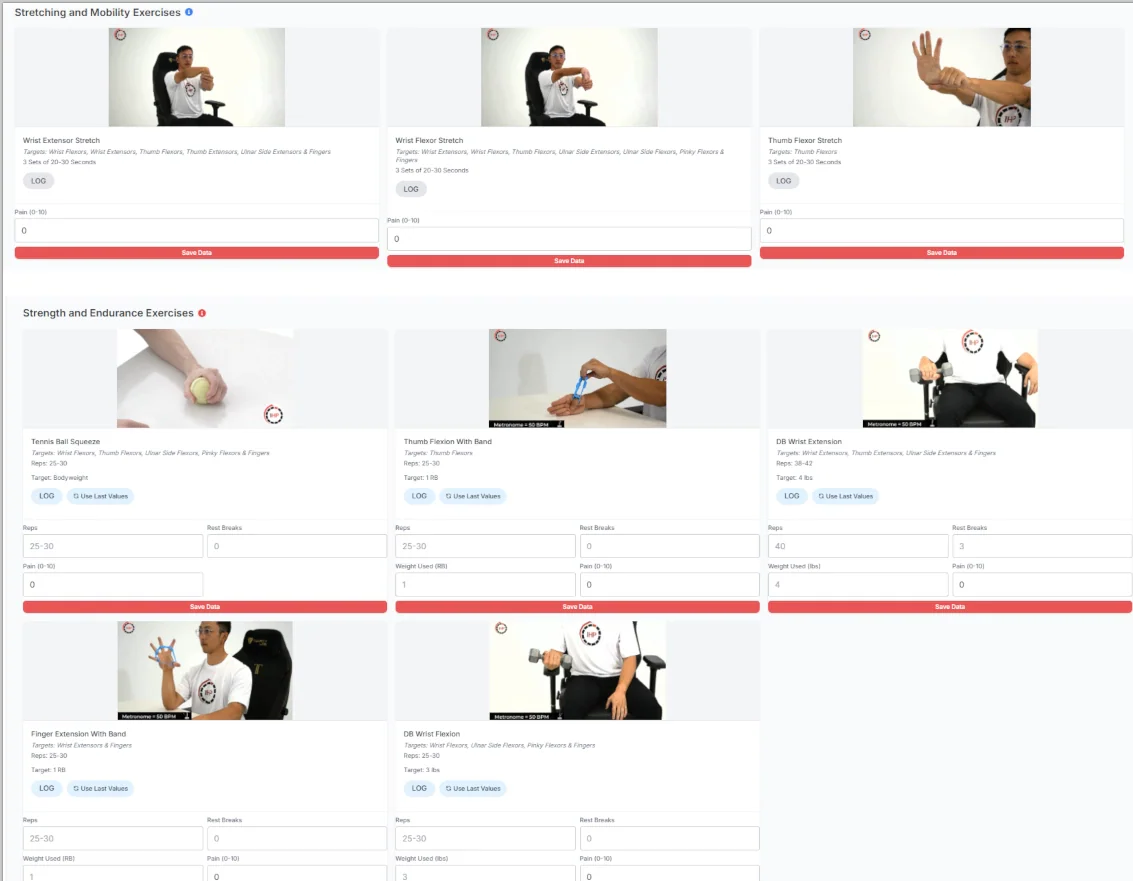
We started conservative. Three sets of 12–15 reps for wrist flexion and extension, targeting the specific muscles that were failing him. We kept the load light at 1% of bodyweight and focused on consistency over intensity.
The key instruction: some discomfort during exercise is normal and expected. It does not mean damage. This is likely the sticking point for many individuals when they try a load-based program. Without an understanding of pain, it can feel scary to feel “safe” or understand that you aren't damaging anything when you feel an increase in symptoms after performing exercises that challenge your endurance.
It was absolutely necessary to teach Julian how to distinguish between the pattern of sharp, alarming pain with associated weakness of true tissue strain, and the dull, achy discomfort of muscles being asked to work harder than they are used to. This is not easy to understand and took consistent education and reassurance based on real evidence (normative values & sensitization established through FACS).
We also addressed how he was managing his overall schedule. During his work periods he would have no structured breaks for a duration of up to 10 hours of PC use. We gradually exposed him to more overall load that we knew he could handle each week — starting with 75/25 (dictation/typing) to 50/50 with movement breaks.
Phase 2: Progressive Loading (Weeks 4–8)
As Julian saw progress it helped motivate him to stay consistent with his programming. Since day 1 Julian committed to every aspect of the program, from the high exercise volume to the daily and weekly pain reframing work. This was a large reason why Julian was able to make such great progress throughout this phase despite his long-standing chronicity.
By week 4 Julian was tolerating the exercises well, which allowed us to progress him to 3 sets of 20–25 reps and increase the extension load to 5 lbs. We added thumb-specific exercises using a variable-resistance finger device to target the functional strength he needed for gaming and trading. The combined reps prescribed across each of the muscle groups were up to 240 per day.
Yes, this sounds like a lot, but with the lower % bodyweight and focus on endurance Julian was able to handle this and promote faster overall adaptations to his endurance. Keep in mind that this volume is NOT what everyone can handle, but is only representative of what Julian's specific case, history, understanding of pain, tolerance to discomfort and other environmental variables allowed him to handle.
By week 7, Julian completed a 4.5-hour gaming session — something he had not been able to do in years. He described it as “a major accomplishment.”
We also introduced conditional deloading during more aggressive pushes. After any day where we pushed the overall activity, due to the increase in real load we intentionally reduced the load the next day by 30–40% to allow adaptation (physically and mentally).
Phase 3: Reintegration & Self-Management (Weeks 8–16)
By week 8, Julian was typing 3–5 hours per day and gaming 3–4 hours with manageable symptoms. As he developed more overall confidence in his hands we also shifted focus to building his overall conditioning by integrating walking 60–90 minutes daily, general strength work, and gradually expanding his activity tolerance.
The goal in this phase was to continue helping him build confidence in using his hands for more overall activities and show himself (and his brain) that he has built the capacity to handle more than he realizes. Graded exposure with integrated cognitive behavioral therapy helped ensure Julian knew how to better process any symptoms as he introduced more activity.
It was important for us throughout this process to work on his response to flare-ups. In week 8, Julian had a pain spike after a longer gaming session. In the past for Julian this would have meant a week of rest, having to “stop gaming” for an extended period of time.
Instead, through everything he learned and our cumulative work in building confidence in using his wrist & hands, he recognized it as an elevated symptom, not a setback. He was able to reflect appropriately to determine the actual variables that led to the increase in symptoms (a sharp increase in the volume of his gaming over a short period of time) and continued his program. With relative deloading while still doing the exercises, the pain resolved within a few days.
This was a milestone during his recovery because it showed him that his response and understanding of pain was crucial in helping him better navigate the natural ups and downs of recovery.
Pain Science Education
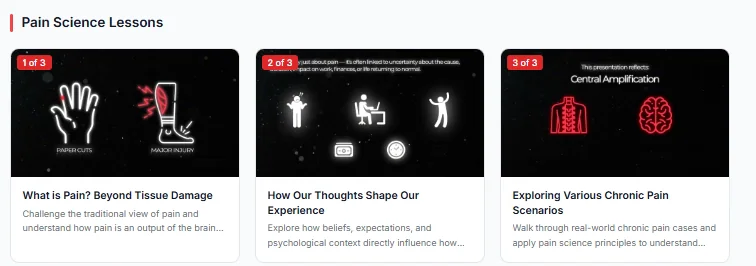
Alongside the physical programming, Julian worked through our pain science curriculum (partnered with a researcher to build a course specific to RSI injuries). The module on fear-avoidance was the one that really helped him better understand how to respond to pain.
“Learning how to respond to pain was the big thing. I would always think, ‘Oh, I'm feeling pain, let me stop.’ After going through the module on pain and the fear-avoidance response, I realized… okay, I'm not damaging myself just from feeling pain. It's okay to continue with my activity, and I'll be fine.”
This shift in mindset — from “pain equals damage” to “pain is information, not a stop sign” — is what allowed Julian to stay consistent for the first time in 16 years.
The Results
By week 12, Julian reported approximately 90% recovery — occasional aching after prolonged activity or on waking, but nothing that limited him.
By week 16, Julian was completing 3 sets of 20–25 reps at 7 lbs for wrist extension and flexion, with rubber band exercises at 3 sets of 30 reps. He was gaming 4–6 hours per day. He was working full days as a trader. He was using a mouse without a second thought.
“I can play for hours — six hours a day if I wanted to. Type, use the mouse, just fine. Sure, I have some aches and pains still there when I do a lot, but nothing that limits me. Even my mindset when I do feel pain is completely different. No fear. No ‘okay, let me stop, let me avoid what I'm doing, let me over-rest for a day or two.’ I feel like I've finally broken through. Disrupted this cycle I've been in for 16 years.”
I wanted to include this quote for a reason. Julian at 16 weeks was able to handle everything he wanted to functionally, yet on only some days he did have some pain, not all days. The frequency of this scenario was reducing gradually over time, but what was more important was his shift in his mental model of pain.
Our goal is actually never just to “get rid of the pain.” Yes, the pain will go away eventually with higher volumes of activity, but the goal with our work is actually to help individuals recognize that pain is a normal part of the human experience. When you consider all of the variables around any time you feel pain, you can determine why it makes sense you would be feeling some level of discomfort.
“The first couple times I was able to play for six hours and wake up the next day with minimal pain, and when I did feel pain, my response to it was different. I was able to continue the next day as normal, as opposed to falling back into that cycle once again. That gave me a lot of confidence and hope.”
Key Takeaways
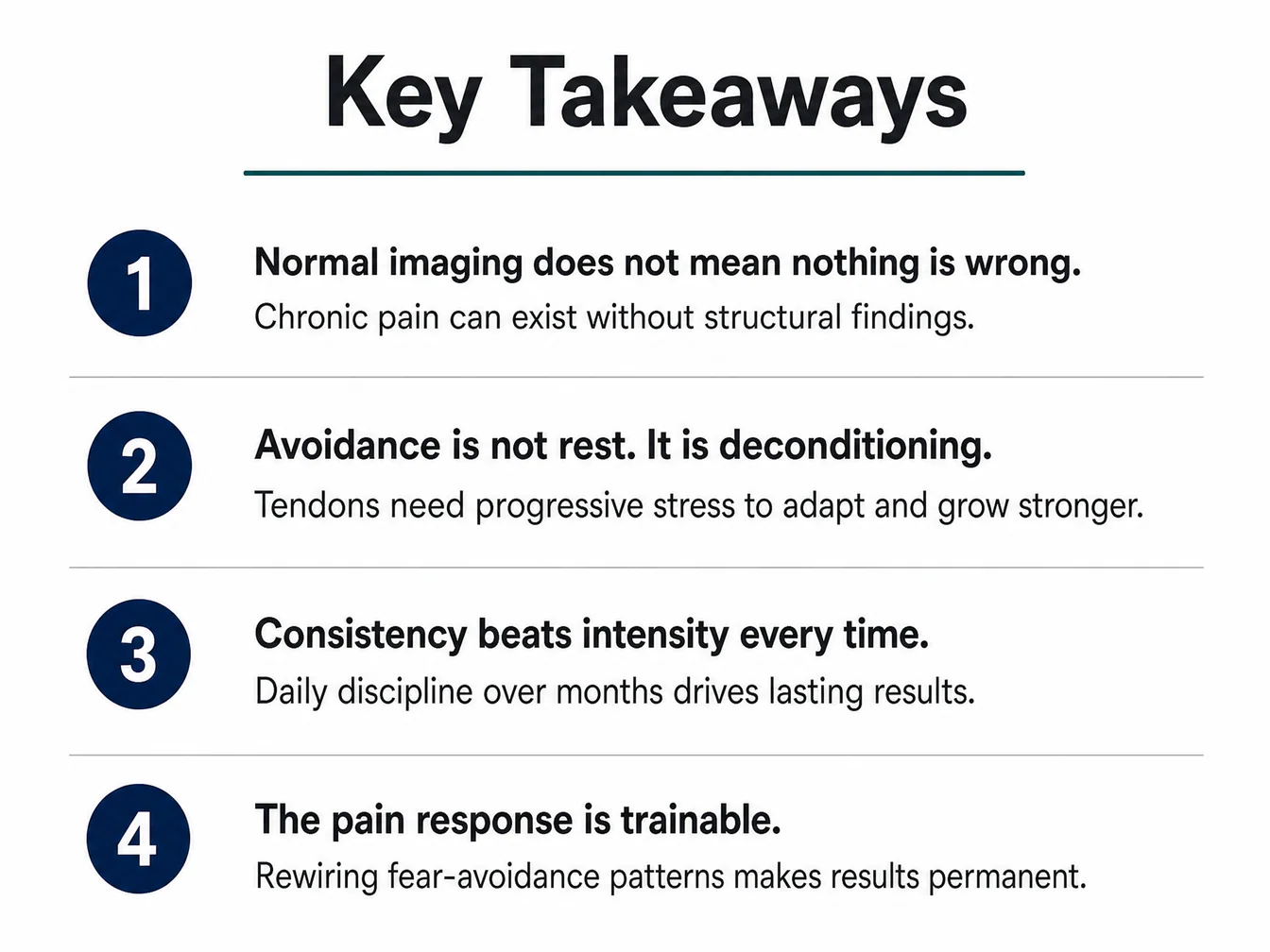
Normal imaging does not mean nothing is wrong.
Julian's MRIs, X-rays, and EMG all came back normal. That is actually very common with chronic tendinopathy and sensitization. The absence of a structural finding does not mean the pain is imaginary, and in many cases physicians do not know how to help you understand why you may still be in pain or functionally limited.
This is often what creates so much anxiety and stress around results and how you are feeling after being told you are “normal.” Your pain is real and there is always a reason for it, whether it be physical, mental or environmental stressors. Being able to work with someone who can provide you this clarity only after assessing everything is how you can feel more safe in using your hands more over time.
Avoidance is not rest. It is deconditioning.
Every time Julian stopped using his hands to “protect” them, he was making the problem worse. Tendons need progressive stress to adapt and handle more repetitive stress over time (endurance). When we continually avoid activity and load, tendons have been consistently shown to weaken and have altered structure. As highlighted throughout this case study, this can also lead to more sensitization through:
- Increased fear of pain and damage with certain patterns of symptoms
- Reduced self-efficacy or belief that you can use your hands for daily and functional activities
- Anxiety around what is actually causing the problem since no “solutions” have been able to help with both function and pain
- Repeated past experiences of elevated pain reinforcing the belief that using hands for a certain period of time is “dangerous”
The goal is never to rest, but to find ways to load appropriately for both your physical and mental state.
Consistency beats intensity every time.
Julian missed at most two days of exercises over three months. This was 190 days of sessions of his exercise program, which often involved 120 reps per muscle group per day, all the while increasing the overall resistance and reps over time. This discipline and consistency — not just the physical and mental exercises — was what drove the main results.
“I think noticing an improvement after two or three weeks really got me like, ‘okay, if I just stay disciplined, stick to the plan, this is going to work.’”
The pain response is trainable.
Julian did not just fix his hands. Through consistent work to better understand pain and why his symptoms would be elevated in certain scenarios, he was able to rewire how his nervous system responds to discomfort. This is the part that makes the results last. Without changing the fear-avoidance pattern, the physical improvements would have been temporary.
Through his disciplined effort and collaborative work to help him reprocess certain scenarios with elevated pain throughout his recovery, he was able to build a better internal framework for managing musculoskeletal / orthopedic issues for the rest of his life.
Final Words of Encouragement
Remember, Julian came to us after 16 years and $15,000 in failed treatments. He was skeptical. He did his research. And once he committed, he was able to show himself he could get back to the life he thought was impossible to have again — in 16 weeks.
You just need a structured approach that actually addresses the underlying issues.
Want Faster Results?
Apply for a Free Comprehensive Evaluation from Physical Therapists Who Understand Wrist Pain
Book Your Free Call Today