
Google Software Engineer Went From Completely Relying on Voice Dictation and Eye Tracking to Full Hands On Workdays in 6 Months
Written by Dr. Elliot Smithson, PT, DPT, MS, ATC
Before
Radial tunnel surgery, voice control, and an eye tracker. Five minutes of typing stopped him. Work disability 100/100.
After (6 Months)
Full workdays of typing. Dead hangs, pull-ups, and heavy lifting 3×/week. Work disability 19/100.
Table of Contents
Michael's Story
A physical therapy handout. Radial tunnel surgery. Nine months of careful rehab on his own, built around a spreadsheet and a metronome. Then a fully voice-controlled computer and an eye tracker, so he would never have to touch a keyboard.
Two years of all that, and five minutes of typing still stopped him cold.
Michael is a software engineer at Google. His whole job is a computer. He also has two young kids, and he couldn't do the dishes, chop vegetables, or pick them up without thinking twice about it.
Six months after he started with us, he was typing full workdays and doing dead hangs, pull-ups, and heavy lifting three days a week. His work disability score went from 100 out of 100 down to 19. Here is exactly how.
Where He Started
Michael works on Google's infrastructure and storage team, mostly from home. That is most of the workday on a keyboard and mouse, plus everything that comes with two little kids: childcare, cooking, cleaning, all of it hand work.
The pain built up over months. No fall, no single injury. Just a lot of keyboard time on top of tissue that wasn't conditioned for it, until it couldn't keep up.
By the time he found us, he had been through the whole standard loop. PT gave him a home exercise sheet that, in his words, was “technically correct but had none of the context necessary to make it work.” He had radial tunnel surgery, which fixed the nerve compression but left the tendon problem untouched. Then shoveling snow and pushing a stroller over rough ground sent him right back to square one.
So he engineered around his hands completely. Voice control for the computer. An eye tracker for the cursor. A timer forcing him off the keyboard every 20 minutes.
That quote about his PT handout is something we hear constantly. The exercises weren't wrong. Nobody explained how to use them.
What We Actually Found
We went through his pain regions and how they behaved, his full history, his daily activity, his setup, a fear-avoidance survey, and our standardized endurance test.
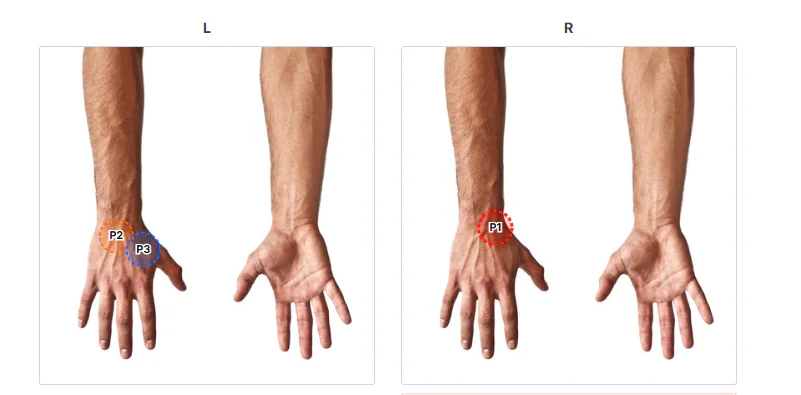
Pain regions: wrist extensors on both sides, worse on the right, and the thumb-side tendons on both hands. The left thumb side had flared further after a recent fall.
Then the number that changed everything. On wrist extension, with 4 pounds at 50 beats per minute, he got 55 to 60 reps before he stopped. And he stopped because his muscles were tired, not because of pain.
Our benchmark for a full workday is about 5% of bodyweight for 60 straight reps. For Michael that is around 7 pounds. So he was already at roughly 60% of where he needed to be.
He had been training like he was at 10%. For months he had been using 1 to 2 pound weights, broken into short sets, because he was afraid of setting himself back.
“I guess the surrounding muscles are weakened, but the tendons are structurally sound.”
That was a good sign on day one.
His fear-avoidance score was high. He fell into what we call a Profile B case: decent physical capacity, moderate sensitization. What he was letting himself do was well below what his body could actually handle, and the gap was growing.
The Part He Couldn't See
Michael already knew about sensitization. He had read about it. On our first call he said, “Some part of it might be that I'm overly sensitized because I constantly pay attention to it.”
But knowing something and changing what you do about it are two different things.
He kept his pain under a strict 5 out of 10 ceiling. He had replaced his entire computer setup. He had stopped gaming. He had stopped lifting. He hadn't really tried to bring the keyboard back at all.
Every one of those decisions made sense on its own. Together, they were keeping him stuck.
- The voice control wasn't protecting his tendons. It let them keep losing capacity while his brain built more fear around the keyboard.
- The pain ceiling wasn't protecting tissue. It kept the load too low for his tendons to ever adapt.
- Dropping the gym and gaming wasn't protecting his hands. It was draining the extra capacity that would have made everything else easier.
That is the trap. Avoidance feels protective. It is actually just a slower way of staying stuck.
The Plan
We went after two things at once: closing the endurance gap, and taking apart the habits that were keeping him sensitized.
Weeks 1 to 4: Building Capacity
We moved him from 1 to 2 pounds up to 4 pounds right away, with a goal of 7 pounds for 60 straight reps. We switched him from short broken sets to continuous reps at 50 beats per minute, because that is the stimulus that actually builds endurance.
We gave him a clear working range: 2 to 4 out of 10 during exercise, settling within 30 minutes. And we spelled out what real tissue strain looks like: sharp pain at 5 or 6 out of 10, weakness when gripping, still there the next day. Anything below that was the right amount of load, not damage.
We also started tracking his keyboard time. Five minutes of typing, logged, and built from there.
Weeks 4 to 10: Graded Exposure and Pain Science
This is where Profile B cases either take off or stall. Michael already knew the vocabulary. What he needed was a way to use it in the moment.
So alongside the physical reps, we gave him mental curls. When pain goes up and a scary thought shows up, you notice it, pause, and pick a response based on evidence instead of fear. The keyboard and pressure through his hands weren't signs of damage. They were learned danger signals. And his own test numbers became the counterargument: “You just did 55 reps at 4 pounds. Does that match how disabled you feel?”
By week 3 he was using this on his own, on things we hadn't even talked about. A sharp pain during a deep squat. A case of plantar fasciitis he had had for six or seven years and never connected to any of this.
By week 7, he was back in the gym doing heavy compound lifts.
Weeks 10 to 26: Finishing Work
The big wrist and forearm muscles came back on schedule. The thumb muscles took longer, which is normal. They are smaller, and his hypermobility added to it.
We moved him to push, pull, legs three days a week as his long-term maintenance. The gripping in those lifts keeps the recovered muscles conditioned, and targeted band work handled what was left in the thumbs. Dead hangs, pull-ups, dips.
By month 5 he was typing full workdays. By month 6 he was close to done.
How His Thinking Changed
Alongside the training, Michael worked through our pain science curriculum and the Explain Pain handbook.
The biggest shift was going from thinking about damage to thinking about capacity. Pain as a sign that tissue is getting tired, not that it is failing. He also noticed his worst days lined up with stress, bad sleep, and a heavy week, not with anything he had done with his hands. Two little kids, house repairs, and production incidents at work will do that.
Late in the program we asked him what goes through his head when he feels pain during an exercise. He said:
“My muscles are tired. It's not that I'm doing damage, but I am pushing past my current capacity.”
That is the sentence we are trying to get everyone to.
The Results
Six months, starting from five minutes of typing, after a surgery and two years of care that didn't work.
His QuickDASH scores, a standard measure of how much your arms and hands limit you:
| Measure | Start | Six months |
|---|---|---|
| Core disability | 66 / 100 | 30 / 100 |
| Work disability | 100 / 100 | 19 / 100 (81% drop) |
He is typing full workdays. He is doing dead hangs, pull-ups, heavy bench, rows, and dips three times a week. He picks up his kids, chops vegetables, and drives without thinking about his hands.
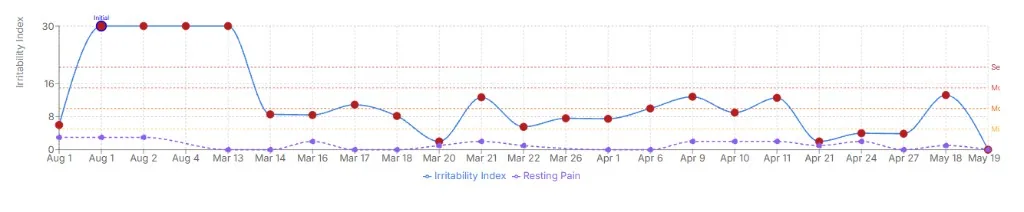
His irritability index came down over the course of care, while resting pain stayed low. On this scale, 30 is the maximum irritability.
He also wrote to Google's internal code-by-voice group, engineers who rely on dictation because of their hands, and recommended us. Several of his colleagues have since started with us.
“I feel like I've reclaimed a lot of my life.”
What to Take From This
Surgery fixes what it fixes, and nothing else.
His radial tunnel surgery was probably the right call at the time, and it did help the nerve. But it couldn't build two years of lost endurance, and it couldn't touch the sensitization that came with it. When someone comes to us after surgery still in pain, that is almost always why.
Avoidance feels protective, but it is slow deconditioning.
Every choice Michael made, from voice control to the eye tracker to the pain ceiling, was reasonable. Together they added up to two years of lost capacity and a nervous system on high alert.
Underloading is just as much of a problem as overloading.
He was at 60% of his target and training like he was at 10%. Tendons adapt to the load you give them. If the load never challenges them, they never change.
The mental model is what lasts.
Michael's pain didn't vanish on one particular day. What changed was how he relates to it. When it shows up now, he knows what it means and what to do. That is the actual goal, and it is what keeps people from ending up back where they started.
Michael found us after two years, a surgery, and a computer setup built entirely around not using his hands. He was skeptical, he lives in data, and he had already tried to solve it himself. Once he committed to the loading, the pain science, and the behavior work, he got his life back in six months.
The detail worth remembering: Michael was at 60% of his target on day one and had been training like he was at 10%. Most people who have been in pain for a long time are underloading, not overloading. The only way to know which one you are is to measure it.
If this sounds familiar
Book a free consultation. We'll measure your capacity and lay out a plan for your situation.
Book Your Free Call